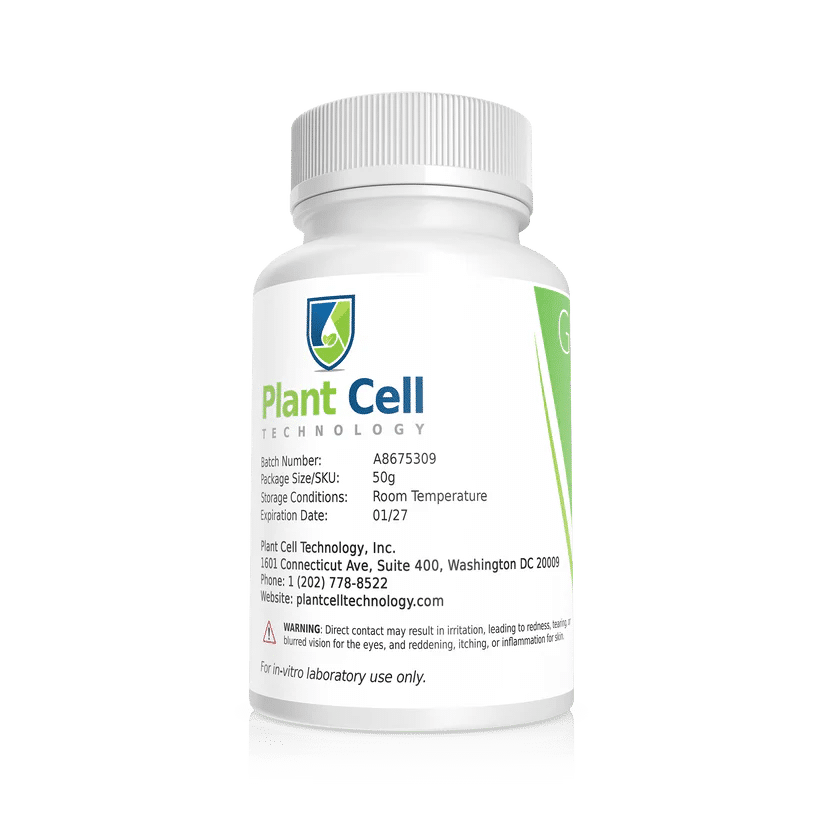
Description
Expiration Standard: 18 months from the manufacture date
Storage Conditions: Shelf stable at room temperature
Melting point 70-80°C
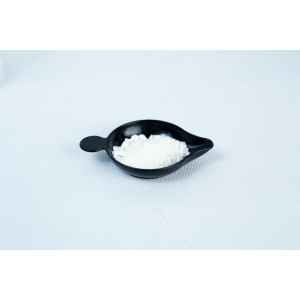
Gellan gum, an anionic polysaccharide, replaces agar in various clinical, bacteriological and plant tissue culture media. Its structural composition comprises a repeating tetrasaccharide unit, including two D-glucose residues, one L-rhamnose residue, and one D-glucuronic acid residue.
It is an excellent alternative for nutrient media in plant tissue culture, yielding a clearer and more transparent gel than agar. Additionally, it requires only half the concentration of agar typically used in tissue culture media.
The Benefits of Gellan Gum
- Easy to use
- Acts as a solid support for the growth and development of explants
- Allows the absorption of nutrients by the plant cells
- The gel’s transparency allows one to see the development of roots or contamination from the start.
- Cost-effective
- Solidifying agents play a crucial role in tissue culture media by providing the necessary support to keep cells, tissues, or explants in place and ensure optimal nutrients for growth and development.
How To Use Gellan Gum
Follow the steps below to prepare 1 litre of tissue culture media using PCT’s Gellan Gum:
- Take a beaker and add 800 mL of distilled water to it.
- To the water, add PCT’s MS Media (or alternative media) 4.54 grams, 30 grams of sugar, and PPM™ (generally 1-2 ml/L).
- Make up the volume of the media to 1000 mL.
- Adjust the pH of the media between 5.4 and 5.8.
- Add 3-4 g/L of PCT’s Gellan Gum to the media and keep stirring.
- Autoclave the medium for 20 minutes at 15 psi and 121℃.
Your media is ready!
FAQ
What is the difference between high acyl and low acyl gellan gum?
Both come from the same place. Gellan gum is a polysaccharide made by fermenting a bacterium called Sphingomonas elodea. Straight out of the fermenter, the polymer chain carries two acyl groups, glyceryl and acetyl, hanging off one of the sugar units. That is high acyl gellan, or native gellan.
Treat it with alkali and those groups come off, and what you are left with is low acyl gellan. GESOLGEL™ MTC is a low acyl product.
The reason that one chemical step matters so much is that those side groups get in the way. Strip them off and the chains can pack in tight, forming ordered double helices that cross link into a rigid network. Leave them on and the chains never quite line up, so you get a loose, flexible network instead. Everything below follows from that.
Texture. Low acyl sets hard and a bit brittle. It cuts cleanly under a scalpel and holds its shape, which is what you want when you are slicing and replating. High acyl is soft and rubbery. Press it and it springs back rather than breaking.
Clarity. Low acyl gels are optically clear, so you can see root development, callus and any early contamination without opening the vessel. High acyl runs hazy to opaque. This alone is why most tissue culture protocols specify low acyl.
Setting and melting. Low acyl sets somewhere around 30 to 50°C and, once it has set with enough cations present, is close to thermally irreversible. It will sit happily in a warm incubation room without slumping. High acyl sets much higher, around 70 to 80°C, and is properly thermoreversible, so it will remelt if you heat it again.
Cations. Worth knowing before you make up a batch: low acyl gellan needs divalent cations, calcium and magnesium, to gel properly. Standard MS or WPM salts supply plenty, so in normal use this is a non issue. It only bites you on a low salt custom medium, where you can end up with a disappointingly weak gel. High acyl gels largely on its own and is far less fussy about ion content.
Syneresis. Low acyl gels weep a little liquid over time. High acyl gels essentially do not, which is worth considering if your cultures sit for a long time between transfers.
How much you use. Low acyl runs at roughly 2 to 5 g/L for tissue culture. High acyl needs more to reach anything like the same firmness, and even then the feel is different, soft rather than rigid.
In short, low acyl is the industry default for plant tissue culture, because clarity and a firm, sliceable matrix are what most protocols are built around. High acyl still has its place. It is worth a look if you want a softer, more forgiving matrix, better water retention, or if syneresis is causing you grief, and some growers reckon it helps at the rooting stage.